About the Atelier
About the Atelier
“The merit of making an image of the Buddha is immeasurable; it never comes to an end and cannot be counted.”
How the Atelier Began
In the Buddhist tradition, a Buddhist painting is never merely a work of art to be looked at. It carries the Buddha’s teaching, and it accompanies the faithful in offering, worship, contemplative practice and the transmission of the Dharma.
At Qinglong Temple in Tang-dynasty Chang’an, Master Huiguo told Kōbō Daishi Kūkai: “The secret treasury of the mantra teaching lies hidden in the scriptures and commentaries; without the aid of images it cannot be transmitted.” (Goshōrai mokuroku [Catalogue of Imported Items], Taishō canon, vol. 55, no. 2161) In esoteric Buddhism above all, scriptures, ritual manuals and images are closely bound together. The forms, mudrās, attributes, colors and directions of the deities in a maṇḍala usually rest on textual sources and transmitted tradition. A painter therefore needs both an understanding of the scriptures, ritual manuals and iconographic tradition, and sound skill in painting.
The atelier was founded for this reason. With reverence and care, we study the scriptures, ritual manuals and traditional iconography, and on that basis paint dignified Buddhist paintings and maṇḍalas in accordance with the Dharma, carrying this tradition forward.
What Udayanāraṇya Means
The first part of the name, 優填 (Udayana), is taken from King Udayana, who appears in ancient Indian legends of Buddhist image-making. The Sūtra on Making Buddha Images (Taishō canon, vol. 16, no. 692) tells how the king feared he would no longer see the Buddha after the Buddha’s final passing (parinirvāṇa). He wished to make an image through which he could continue to honor and serve the Buddha; in response, the Buddha taught him the many merits of making images. The second part, 蘭那, stands for 阿蘭那 (araṇya, also written 阿蘭若): a quiet place, far from noise and suited to practice.
The name 優填蘭那 (Udayanāraṇya) carries the aspiration, with a reverent heart and a commitment to learning, to study and paint Buddhist paintings and maṇḍalas in accordance with the Dharma, and to carry their tradition forward.
The atelier seeks to spread the Dharma through painting. Following the exoteric and esoteric scriptures, ritual manuals and traditional iconography, we give careful attention to every figure, every attribute and every color, so that each Buddhist image is accurate and true to the Dharma, as well as dignified and beautiful. We hope these works will serve in study, practice, Dharma assemblies and other Buddhist observances, and that those who wish to learn Buddhist painting will join us in preserving and continuing this precious tradition.
Who Paints Here
The atelier was founded by Venerable Laihai together with students. As representative and principal painter, Venerable Laihai leads the iconographic research, the painting and the teaching; the students, while continuing their own training, look after the website, correspondence and day-to-day affairs.
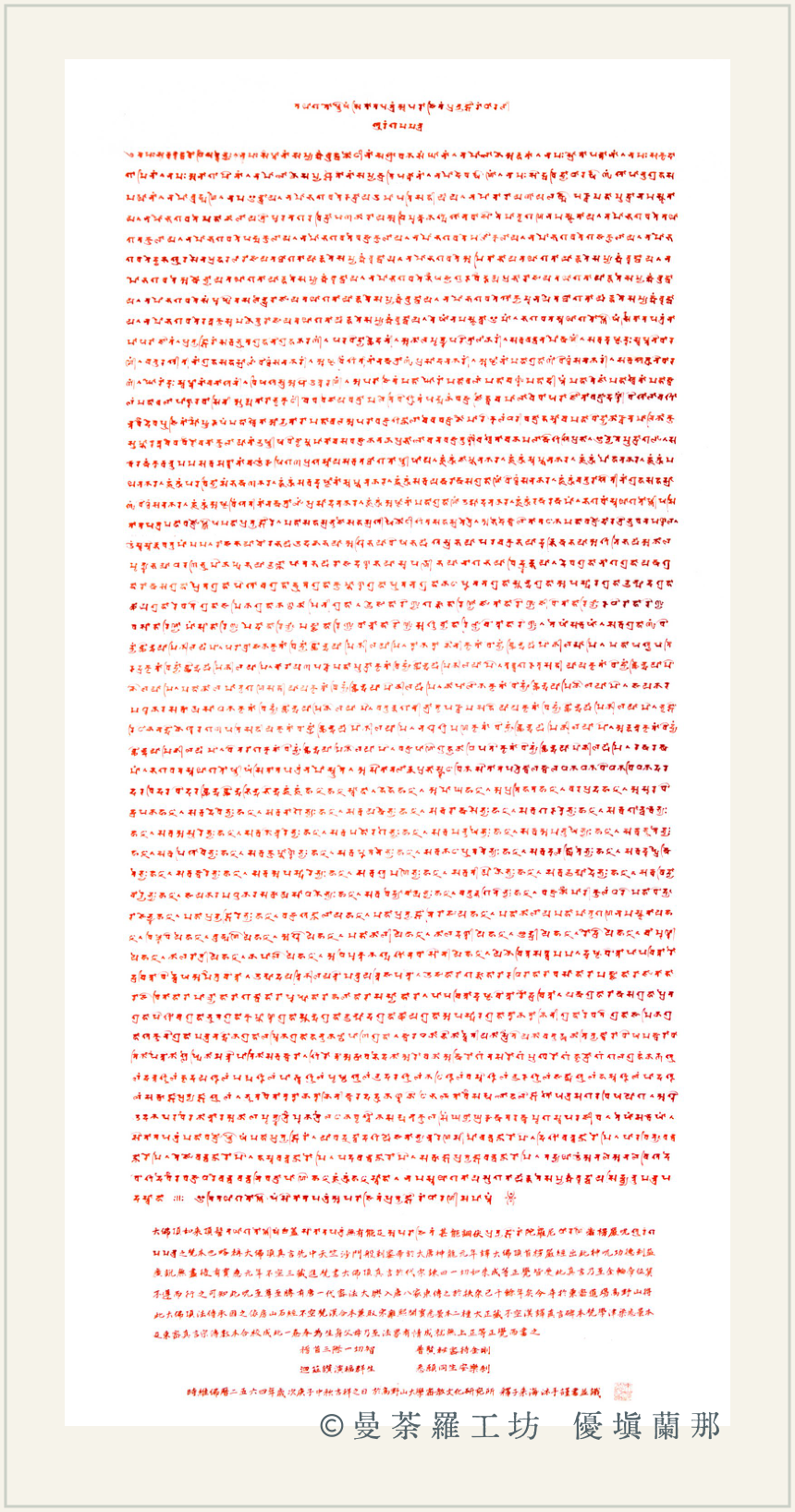
To date, the atelier has painted many Buddhist works for temples, monastics and lay devotees in China and Japan, including Star Maṇḍalas, an image of Ākāśagarbha Bodhisattva for the Gumonji-hō (an esoteric rite for strengthening memory), maṇḍalas of the Two Realms rendered in Siddhaṃ script, a portrait of Great Master Zhiyi of Tiantai, and portraits of contemporary monastics.
 © Maṇḍala Atelier Udayanāraṇya
About Venerable Laihai
Graduate of Tsinghua University; Ph.D. in Esoteric Buddhist Studies, Koyasan University. Trained at Mount Kōya and received the consecration for Dharma transmission (denpō kanjō); studied the Chūin-ryū, Sanbōin-ryū and other lineages of Tōmitsu (Shingon esoteric Buddhism). Studied Jiun-school Siddhaṃ and the maṇḍalas of the Two Realms in Siddhaṃ script under Ācārya Shizuka Jien, and Buddhist painting and maṇḍala painting under the painter Fujino Shōkan at the Buddhist painting studio Rakushisha. Currently teaches at Koyasan University, researching the history and thought of Chinese esoteric Buddhism and the painting of Buddhist images and maṇḍalas.
Every work of the atelier is painted under Venerable Laihai’s direction and receives Venerable Laihai’s final review, seeking a careful and harmonious balance between scriptural basis, religious use and pictorial beauty.